


Purification engineering technology research center of Sichuan Province Natural Medicine
四川省天然药物分离纯化工程技术研究中心
文献
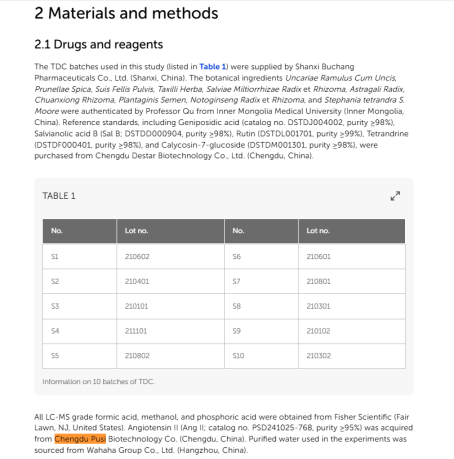
Liu J, Li J, Zhang W, Dong Y, Wang F, Liu J, Wang Y, Zhang Q and Du X (2025) Association analysis-based screening strategy for quality markers of Tengdan capsule in the treatment of hypertensive renal disease. Front. Pharmacol. 16:1647921.
本文来自: 发布时间:2026-05-18
Abstract:
Background and Aim: Hypertensive Renal Disease (HRD) is a chronic and progressive condition driven by sustained high blood pressure, which leads to renal fibrosis and, eventually, end-stage kidney failure. Tengdan Capsule (TDC), a traditional Chinese medicinal formulation, has shown therapeutic potential for managing HRD. However, the specific quality markers (Q-markers) responsible for its efficacy and the underlying molecular mechanisms remain insufficiently understood. This study aimed to identify candidate Q-markers of TDC and elucidate the molecular pathways through which it exerts its renoprotective effects, using an integrative association analysis-based approach.Methods: The chemical composition of TDC and its potential Q-markers were systematically characterized through in vitro and in vivo profiling using HPLC-Q-Exactive-MS and chromatographic fingerprinting. Transcriptomic analysis was conducted on angiotensin II-stimulated HEK293T cells to identify differentially expressed genes (DEGs) responsive to candidate Q-markers. Mendelian randomization (MR) analysis based on genome-wide association study (GWAS) data was employed to validate causal genes linked to HRD. Furthermore, untargeted metabolomics was performed to explore metabolic changes associated with transcriptomic targets.Results: A total of 82 chemical constituents were identified in TDC, 51 detected in vivo. Chromatographic fingerprinting across 10 production batches demonstrated high consistency. Integrated analysis of chemical profiling and fingerprint data highlighted Salvianolic acid B (Sal B) as a potential Q-marker. Transcriptomic profiling revealed 210 DEGs enriched in immune and fibrotic pathways. MR analysis identified Killer Cell Lectin Like Receptor D1 (KLRD1) as a protective gene associated with reduced HRD risk (IVW p = 0.00797), with no evidence of horizontal pleiotropy or heterogeneity. Metabolomic profiling identified five key metabolites, among which α,α′-diethyl-3,4,4′-stilbenetriol showed a strong correlation with KLRD1 expression, indicating a potential immune–metabolic regulatory axis.Conclusion: This study presents a novel framework for Q-marker identification in traditional herbal formulations using association-based multi-omics integration. Salvianolic acid B and KLRD1 were key indicators of TDC’s quality and efficacy. These findings offer new mechanistic insights into the action of TDC and support its standardized evaluation and therapeutic application in HRD management.
https://doi.org/10.3389/fphar.2025.1647921

 关注官方微信